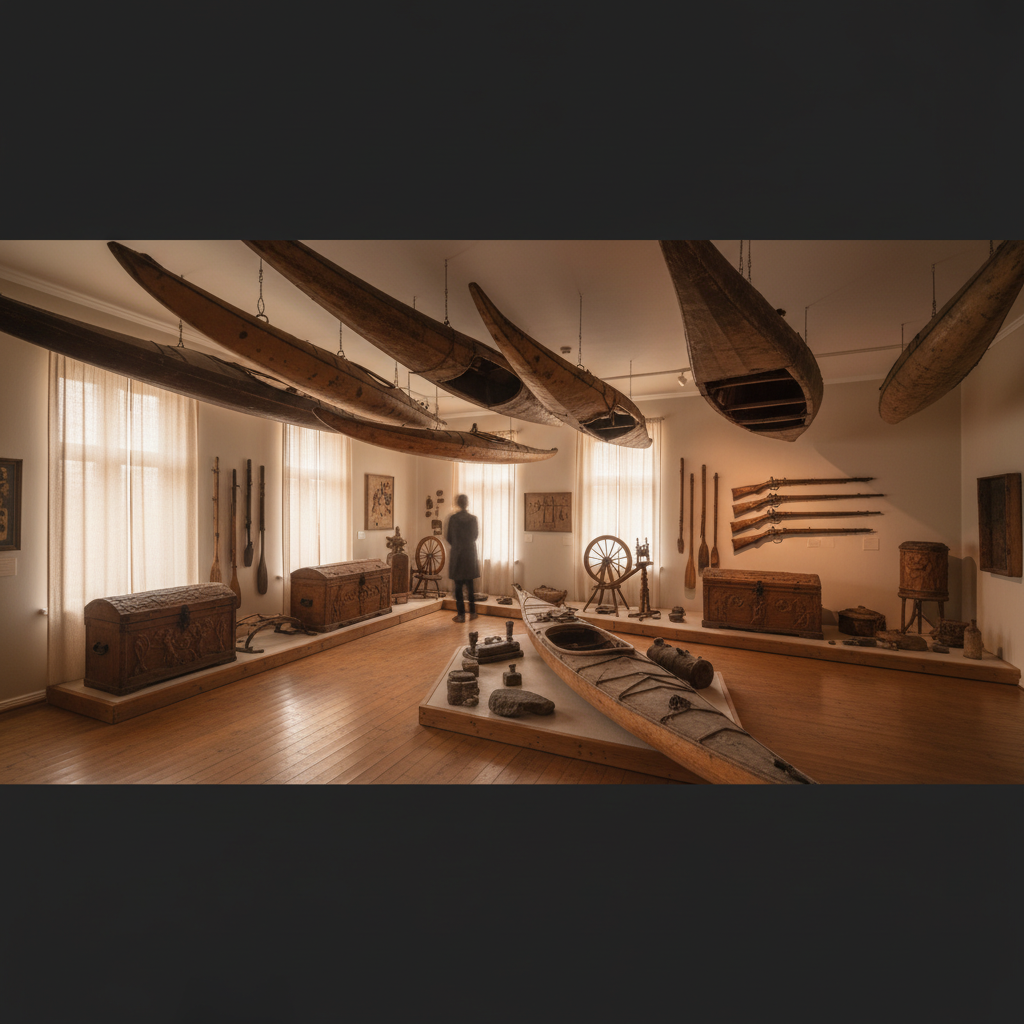
Sisimiut, Greenland’s second-largest town, is not only a gateway to the Arctic Circle Trail and a hub for outdoor adventure — it is also home to one of the country’s most comprehensive museums. The Sisimiut Museum (in Greenlandic: Sisimiut Katersugaasiviat) offers a deep dive into 4,500 years of human settlement along the Davis Strait coast. Through carefully curated exhibits, historic buildings, and hands-on displays, the museum tells the story of the region’s Indigenous cultures, colonial encounters, and the modern town that emerged.
Located in the old town center at Jens Kreutzmannip Aqqutaa 6, the museum occupies a cluster of preserved wooden structures from the 18th and 19th centuries. Its collections span from prehistoric Dorset and Thule artifacts to 20th-century fishing and hunting gear. This article explores the museum’s key exhibits, its historic buildings, and how it connects to the broader story of Greenland’s west coast — a story that continues to unfold today.
The Archaeological Collection: From Dorset to Thule
The museum’s archaeological collection is its crown jewel, containing objects that trace human occupation back to the Dorset culture (c. 500 BC – 1500 AD) and the later Thule culture (c. 1200 AD – present). Excavations in and around Sisimiut have yielded tools, weapons, and household items made from bone, stone, and driftwood.
Dorset Culture Artifacts
The Dorset people, who preceded the Thule, left behind distinctive small tools and carvings. The museum displays:
- Harpoon heads carved from walrus ivory, with intricate geometric patterns.
- Soapstone lamps (qulliq) used for heating and cooking.
- Bone needles and awls, evidence of sophisticated skin-sewing techniques.
- Miniature carvings of animals, possibly used in shamanistic rituals.
These objects, many found at sites like Itinnera and Qeqertarsuatsiaat, reveal a culture adapted to a harsh environment. The museum’s labels explain how Dorset people built semi-subterranean houses with turf walls and used kayak-like boats for hunting seals.
Thule Culture and the Rise of the Inuit
The Thule culture, ancestral to modern Greenlandic Inuit, arrived around 1200 AD, bringing larger boats, dog sleds, and advanced hunting technology. The museum’s Thule gallery features:
- A full-scale replica of a Thule winter house with stone and turf walls, a whalebone frame, and a sleeping platform.
- Umiak frames (open skin boats) used for whaling and transport.
- Dog sled components, including bone runners and harnesses.
- Harpoons and floats for hunting bowhead whales.
One notable exhibit is a collection of Thule pottery fragments, rare in Greenland because clay was scarce. The museum also displays a qamutik (sled) from the 18th century, found preserved in permafrost near Sisimiut.
The Colonial Era: Buildings and Stories
The museum itself is housed in several historic buildings from the Danish colonial period. Sisimiut was founded as Holsteinsborg in 1756 by the Danish-Norwegian missionary Hans Egede’s son, Niels Egede. The museum’s main building, the Old Mission House (built 1840), served as a school and residence for missionaries.
The Old Mission House
This yellow wooden building, with its white window frames, is a classic example of colonial architecture. Inside, period rooms recreate the living quarters of a missionary family: a kitchen with a cast-iron stove, a parlor with a piano, and bedrooms with iron bedsteads. The walls are lined with photographs from the 1880s–1920s, showing Inuit families in traditional dress and Danish officials in uniform.
The Trade Building (Bod)
Adjacent to the mission house is the trade building (built 1860), originally a store for the Royal Greenland Trading Department (KGH). Here, the museum displays trade goods such as:
- European textiles (wool, cotton) exchanged for seal skins.
- Glass beads used as currency.
- Iron tools and rifles that transformed Inuit hunting.
- Bales of dried cod and barrels of seal oil, key exports.
This exhibit illustrates the economic and cultural exchange that reshaped Greenlandic society. The trade building also houses a small post office with original stamps and postal equipment from the early 1900s.
The Boat Shed and Fishing Exhibits
In the boat shed (built 1880), the museum preserves a collection of wooden fishing boats and kayaks. Notable is a 1940s motorboat built by local shipwright Peter Rosing, used for cod fishing. Nearby, a display on shrimp processing features machinery from the 1960s, when shrimp became Sisimiut’s economic backbone. Today, the town’s harbor is home to Royal Greenland’s shrimp factory, one of the largest in Greenland.
Kayaks, Umiaks, and Boats: The Maritime Collection
Given Sisimiut’s location on the Davis Strait, it is no surprise that the museum has an outstanding maritime collection. The Kayak Hall (separate from the main building) houses over 20 kayaks, from 19th-century hunting kayaks to modern fibreglass models.
Traditional Hunting Kayaks
The oldest kayak in the collection dates from 1875 and was built by hunter Karl Møller. It is made of driftwood frames covered with sealskin, with a length of 5.5 meters and a beam of just 50 cm. The museum explains the construction process: the frame is lashed together with sinew, and the skin is sewn with waterproof stitches. Visitors can see tools used for kayak building, including bone scrapers and ivory needles.
Umiaks and Whaling Boats
The umiak, a larger open boat used by women for transport and whaling, is represented by a 6-meter-long example from the 1920s. The museum also displays a whaleboat from the American whaling era (1800s), when ships from New England hunted bowheads off Greenland’s coast. A map shows the routes of whalers and the location of abandoned whaling stations, such as the one at Kangersuatsiaq.
Outdoor Exhibits and Seasonal Activities
The museum’s grounds feature several outdoor exhibits, including a peat house (turf hut) and a drying rack for fish and meat. During summer, visitors can watch demonstrations of kayak rolling by local hunters, and in winter, the museum organizes dog sled rides on the frozen fjord.
One of the most popular attractions is the Whale Bone Arch, a structure made from the jawbones of a bowhead whale, located near the museum entrance. It serves as a photo spot and a reminder of the central role whales have played in Inuit culture.
Planning Your Visit
The Sisimiut Museum is open year-round, but hours vary by season:
- June–August: Daily 10:00–17:00
- September–May: Monday–Friday 13:00–16:00
Admission is 50 DKK for adults, free for children under 12. The museum offers guided tours in English and Danish (advance booking recommended). For those interested in learning more about the region, the museum’s small shop sells books on Greenlandic history and local handicrafts.
Sisimiut is easily accessible via Air Greenland flights from Kangerlussuaq and Nuuk, or by Sarfaq Ittuk coastal ferry. If you are planning a longer stay, the Complete Guide to Sisimiut, Greenland 2026 covers accommodation, dining, and excursions. Many visitors combine a museum visit with hiking the Arctic Circle Trail, which starts just outside town.
Conclusion
The Sisimiut Museum is more than a collection of artifacts — it is a window into 4,500 years of human resilience and adaptation. From the Dorset people’s tiny soapstone lamps to the Thule’s whale-hunting umiaks, from the colonial trade building to the modern shrimp factory, the museum connects the past to the present. For anyone visiting Sisimiut, it offers an essential context for understanding the town and its people. Whether you are a history buff, a cultural traveler, or a hiker passing through on the Arctic Circle Trail, make time for this remarkable museum.
Related Articles
- The Complete Guide to Sisimiut, Greenland 2026
- How to Get to Sisimiut 2026: Flights, Ferries & Routing
- Arctic Circle Trail: Complete Hut-to-Hut Guide 2026
- Sarfaq Ittuk Coastal Ferry: Sisimiut
- Air Greenland Routes to Sisimiut, Kangerlussuaq & Nuuk