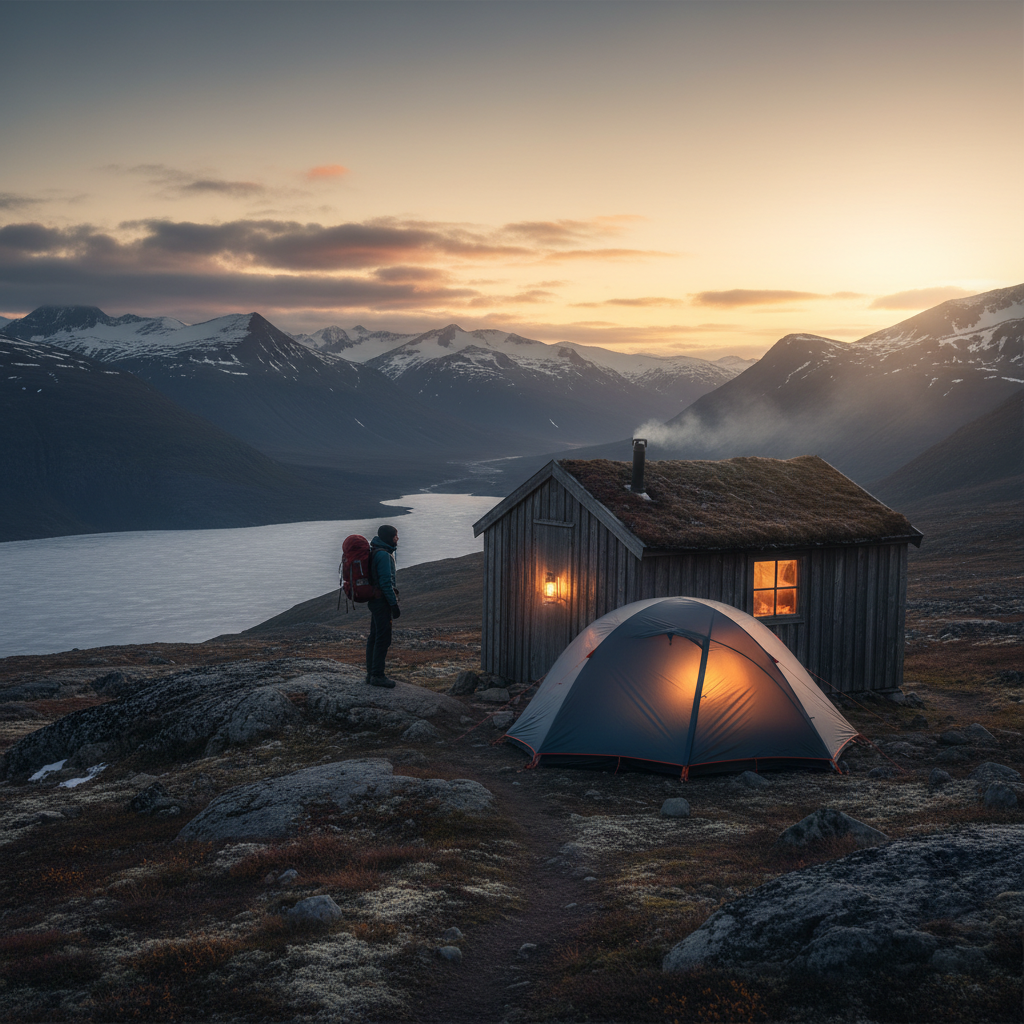
The Arctic Circle Trail (ACT) stretches 160 km from Kangerlussuaq to Sisimiut, crossing the vast tundra of West Greenland. One of the first decisions every hiker faces is whether to rely on the trail’s network of 11 huts or carry a tent. Each option has distinct advantages and trade-offs in terms of cost, weight, comfort, and flexibility. This article breaks down the key factors to help you decide which shelter strategy suits your trip—and when mixing both makes sense.
Before diving into the details, familiarise yourself with the complete hut-to-hut guide and the packing list for ultralight comfort.
Understanding the Hut System
The ACT has 11 huts spaced roughly 10–20 km apart. They are basic timber shelters maintained by the Sisimiut Tourist Office. Each hut sleeps 4–6 people on wooden platforms; you need your own sleeping mat and bag. Huts have a wood-burning stove, a table, benches, and sometimes a small shelf. No bedding, food, or cooking gear is provided. Water must be collected from nearby streams. Huts are free to use on a first-come, first-served basis, but a voluntary donation of 100 DKK per person per night is recommended—deposited in a box at each hut or paid at the Tourist Office in Sisimiut or Kangerlussuaq.
Key huts along the trail (west to east): Sisimiut (trail start), Palasip Qaqqaa, Kangerluarsuk Tulleq, Ikkattooq, Innajuattoq, Eqalugaarniarfik, Qarlitisup Tasia, Ikkattup Tasersua, Nerumaq, Amitsorsuaq, and Kangerlussuaq (trail end). The huts at Palasip Qaqqaa and Nerumaq are newer and in better condition; older huts like Kangerluarsuk Tulleq can be drafty.
Advantages of Using Huts
- No tent weight: Saves 1.5–2.5 kg in your pack, allowing more food or luxury items.
- Weather protection: Strong winds and rain are common; huts offer solid shelter and a stove for drying clothes.
- Social aspect: Meet other hikers; huts foster camaraderie.
- Cost: Free (donation-based), whereas a good tent costs 2000–5000 DKK.
- No setup time: Arrive, light the stove, relax.
Disadvantages of Using Huts
- Limited capacity: Huts fill up in July–August; you may have to wait or push to the next hut.
- No privacy: Shared space with snorers, late arrivals, or early risers.
- Fixed itinerary: You must reach the next hut each day, which can be challenging in bad weather or if injured.
- Condition variability: Some huts are run-down, with broken stoves or holes in the floor.
- Mice and dirt: Rodents are common; floors may be muddy.
Carrying a Tent: Freedom and Responsibility
A tent gives you total flexibility. You can camp anywhere that is not directly on the trail (leave no trace). The ACT is open wilderness; there are no designated campsites except near huts. You must camp at least 100 m from huts and water sources. A four-season tent is recommended due to strong winds. Popular models among ACT hikers include the Hilleberg Anjan (2.2 kg, 7000 DKK), MSR Hubba Hubba (1.7 kg, 4500 DKK), and the budget-friendly Naturehike Cloud Up (2.0 kg, 1500 DKK).
Advantages of Tent Camping
- Flexibility: Stop when tired; camp where you like.
- Privacy: Your own space, no snorers.
- Reliability: No worry about hut capacity or condition.
- Weather independence: You can pitch in any sheltered spot, not forced to reach a hut.
Disadvantages of Tent Camping
- Weight: Adds 1.5–3 kg to your pack; plus a stove if you want to dry gear (huts have wood stoves).
- Setup time: 10–20 minutes to pitch, even in rain.
- Less comfort: No table, bench, or stove; cooking on the ground.
- Exposure: Tents can be noisy and cold in high winds; condensation is common.
Seasonal Considerations
The ACT season runs from late June to early September. Weather varies dramatically.
Peak Season (July–August)
July and August are the warmest months, with average highs of 10–15°C. Mosquitoes are worst in July. Huts are busiest; you may need to tent if you arrive late. A tent gives you flexibility to avoid crowded huts. However, rain is frequent; huts offer a place to dry gear. Many hikers combine both: tent as backup, but aim for huts.
Shoulder Season (Late June & September)
In late June, snow patches remain, and rivers are high. Huts are less crowded, but some may still be locked (trail officially opens June 25). September brings colder nights (below freezing) and fewer hikers. Huts are more available, but the stove becomes essential. A tent alone is riskier due to cold; a four-season tent with a good sleeping bag (-10°C comfort) is needed. Most September hikers rely on huts for warmth.
Cost Comparison
Hut donation: 100 DKK per night (optional but expected). For a 10-day hike, that’s 1000 DKK. Tent cost: a decent tent costs 1500–7000 DKK one-time. If you already own a tent, the marginal cost is zero. If you need to buy, consider renting from the Sisimiut Tourist Office: a tent rental is 300 DKK per day (2025 price). Over 10 days, that’s 3000 DKK – more than the donation. So if you don't own a tent, huts are cheaper. But if you plan multiple hikes, buying a tent is economical.
Also factor in stove fuel. Huts provide free firewood (collected by the tourist office). If tenting, you need a camping stove and gas canisters (100–150 DKK each in Sisimiut).
Logistics and Booking
Huts cannot be reserved. You simply walk in. In peak season, arrive early (before 4 PM) to secure a spot. If full, pitch your tent outside. Some hikers carry a tent just for this reason. The direction you hike affects hut availability: most start from Kangerlussuaq (east) so huts near there fill first; starting from Sisimiut (west) you encounter fresher huts. For more on this, see the guide on which direction to walk the Arctic Circle Trail.
If you tent exclusively, you need to carry more food (no hut-to-hut resupply). Water sources are abundant; treat with a filter or tablets. The complete guide to Sisimiut has details on buying gas and food in town.
Recommendations by Hiker Type
Ultralight Hiker
Go hut-only to save weight. Pack a lightweight sleeping bag and pad. Use a small tarp as emergency shelter. Accept the risk of full huts. Best in shoulder season.
Budget Hiker
Huts are free (donation optional). No tent purchase needed. But you must be flexible with itinerary. Combine with a cheap tent (e.g., Naturehike) as backup.
Group Hiker
Huts sleep 4–6, so groups can fill a hut. Tent backup ensures everyone has space. Groups often split: some in hut, some in tents outside.
Solo Hiker
Huts are social; you’ll meet people. But if you want solitude, tent away from huts. Solo tenting requires self-reliance in case of injury.
Weather and Safety
Weather on the ACT can change rapidly. Fog, rain, and wind are common. Huts offer a safe haven if you are hypothermic or exhausted. In a tent, you must be able to set up in wind and rain. Practice before the trip. Always carry a bivvy bag or emergency shelter even if using huts.
River crossings are dangerous in early season. Huts are often near crossings, so you can wait for water levels to drop. If tenting, you might be stuck on the wrong side.
Packing Strategy
If you plan to use huts primarily, you can leave the tent at home. But many hikers carry a lightweight tent (1.5 kg) as insurance. The packing list article suggests a base weight of 8–10 kg with tent, or 6–8 kg without. Your choice affects food capacity: without tent, you can carry more luxury items.
Sample Gear List (Hut-Only)
- Sleeping bag (-5°C comfort)
- Sleeping pad (inflatable)
- Stove and pot (for cooking in hut)
- Headlamp, matches, knife
- Water filter or tablets
- Dry bags for clothes
- Emergency bivvy
Sample Gear List (Tent-Only)
- Same as above plus tent, footprint, extra stakes
- Stove fuel (gas canister)
- Repair kit for tent
- Lighter weight sleeping bag (if tent warmer)
Conclusion
There is no single right answer. Most experienced ACT hikers carry a tent as a backup, even if they plan to use huts. The freedom to camp anywhere outweighs the weight penalty. However, if you are on a tight budget or want the lightest pack, huts alone are viable—especially in August when weather is mild. Check the flight routes for getting to Kangerlussuaq or Sisimiut, and consider the coastal ferry if arriving by sea. Ultimately, the best shelter is the one that matches your comfort with risk. Plan for the worst, hope for the best, and enjoy the Arctic wilderness.
Related Articles
- Arctic Circle Trail Complete Hut-to-Hut Guide 2026
- Arctic Circle Trail Packing List: Ultralight Comfort
- Arctic Circle Trail Direction: East-West vs West-East
- The Complete Guide to Sisimiut, Greenland 2026
- How to Get to Sisimiut 2026: Flights, Ferries, Routing